

Evenings in our house are usually a little chaotic. With a four-year-old boy and a six-year-old girl, quiet moments are rare. I was downstairs cooking dinner one night when our son came barreling down the stairs: “Mommy, mommy! Geni said a bad word!” We don’t swear in our house, so I’m always curious what qualifies — “What did she say?” His answer: “She said 6, 7!”
That phrase is controversial enough that in our house, we stick with “better safe than sorry.” I asked my daughter if she even knew what it meant. “Not really,” she said — and that got me thinking.
So much of what unsettles us about culture today is exactly that: the meaninglessness of it. From trendy trinkets people impulse-buy online to senseless violence that ends a life over nothing, so much of it traces back to hedonism — the belief that pleasure and happiness are the highest goals in life. My daughter saying “6, 7” because it makes her feel like she fits in with her friends is a small, innocent version of the same thing. But when an entire worldview is built on that foundation, the consequences are anything but innocent.
We are bombarded with information on tiny screens that numb our spiritual senses and keep us from connecting with God. Many of us can’t sit alone in silence for five minutes without feeling anxious — and yet silence is often when we hear Him the loudest. Social media hasn’t just created a dopamine dependency; it’s convinced us we’re lacking everything we see in someone else’s highlight reel. We have never been so flooded with information that makes us feel so empty.
If you’re a Christian, faith gives this dichotomy its answer. Paul tells us in Philippians 1:21 that “to live is Christ and to die is gain.” Our ultimate purpose is to live for the gospel — to spread it and make heaven crowded. Without Christ, life collapses into self-gratification. Without God’s Word as our true north, the sinful nature we’re born into takes over, the flesh rules our decisions, and our spirit slowly begins to die.
Heavy, I know. But stay with me — there’s a silver lining worth the gloom.
A recent Gallup poll found that 42% of men ages 18–29 now say religion is “very important” in their lives. Monthly church attendance among young adults rose from 8% in 2018 to 12% in 2024. Pew Research reports that 28–30% of Catholics attend Mass weekly, with an remarkable 38% of new converts attending weekly. Among evangelical Protestants, 60% attend church weekly — and 43% of Gen Z reports weekly church attendance.
So what’s driving this massive return?
I believe that as hedonism rises, the God-shaped hole in all of us becomes harder to ignore — especially for younger generations. Whether people can name it or not, meaninglessness and the depravity that comes with it feel wrong because they are wired to feel that way. C.S. Lewis put it this way: “My argument against God was that the universe seemed so cruel and unjust. But how had I got this idea of just and unjust? A man does not call a line crooked unless he has some idea of a straight line.” We aren’t born innately good or innately bad, but we are given a sense of right and wrong from our first breath — because we are created in the image of a holy God. What we do with that sense determines whether the flesh or the spirit rules us.
Much of this return to faith has been specifically toward the Catholic Church, which has raised eyebrows across different demographics. But in the context of this conversation, it makes complete sense. If you’ve ever attended a Catholic Mass, certain words probably resonate: tradition, beauty, stability, reverence, values. In a world where none of those things seem to be celebrated by the majority, people starving for direction will naturally be drawn to the place that radiates them most visibly.
The role of beauty in this shouldn’t be overlooked — and here’s where I’ll offer a bit of an art history detour. Fair warning: these are broad observations, though I do have a minor in Design, which required serious study in art history. So here’s my abbreviated dissertation on how the Industrial Revolution damaged our relationship with beauty.
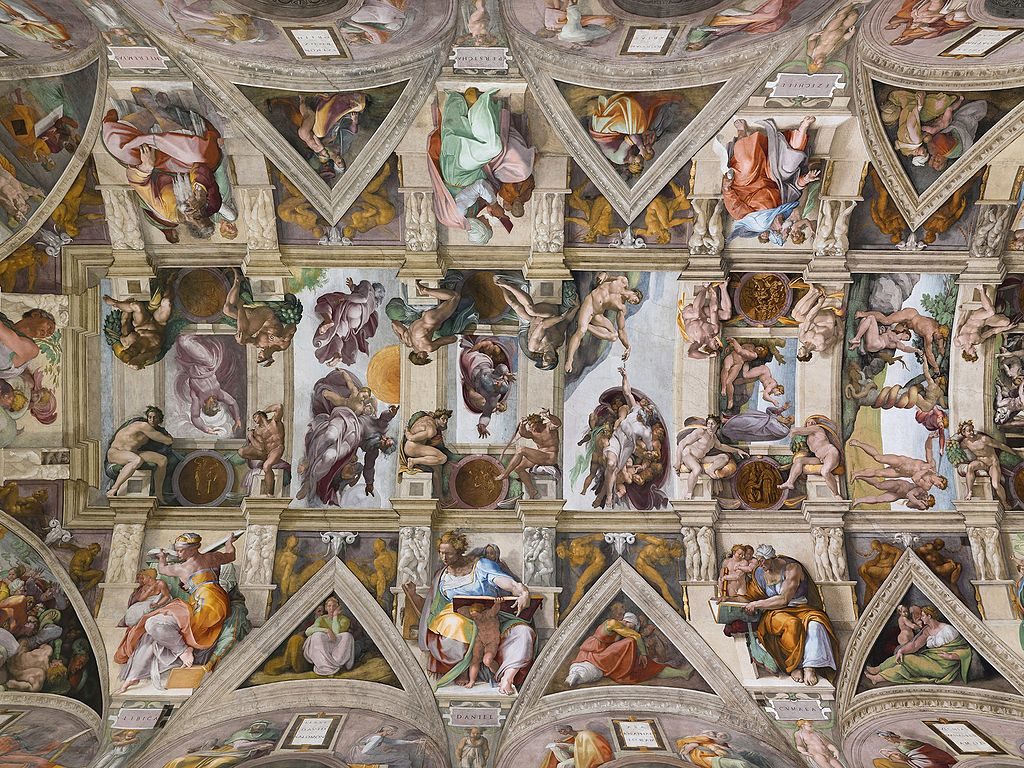
Before industrialization, art took time. It couldn’t be mass-produced. Capturing a person in paint or stone was often the only way to preserve their likeness, and that process was treated as a sacred act — a celebration of what God had made. You see it in Michelangelo’s Sistine Chapel ceiling, in the statue of David, in the Nike Winged Victory of Samothrace, so finely carved that the fabric seems to move in the wind. Leonardo’s Mona Lisa was painted with such precision that she appears to look directly at you across five centuries.
Industrialization and capitalism have genuinely benefited society — they’ve created opportunity and helped people climb out of poverty. But mass production flattens beauty. When anything can be duplicated cheaply, the reverence for the original disappears. And when a culture becomes focused on building a compliant workforce, celebrating individual human beings as children of God becomes secondary. Modernism and minimalism get marketed as sophisticated simplicity, but what we often lose is the capacity to notice what’s noble and beautiful around us — and when that’s gone, the tiny screen fills the vacuum.
To bring it full circle: I believe this return to faith is an awakening. God is reminding his children who they are and what they were made for. The emptiness people are experiencing isn’t fixed by the latest technology or trend — it’s a disconnection from God and the spiritual, and some part of every person knows it.
That said, I want to be honest about something — and these are bold words coming from someone with many dear Catholic friends whom I respect deeply. I don’t think the Catholic Church is the destination for every searching soul. Someone wandering in spiritually lost may walk into an RCIA class, encounter stunning iconography and ancient liturgy, and still leave empty — because beauty without understanding is decoration, not worship. Confessing the same sins week after week without genuine transformation, or kneeling before a statue of Mary as a mediator, misses what grace actually accomplished. My Catholic friends who understand the meaning behind their sacraments are engaging in something real. But the accessibility for the truly lost is a gap the Church hasn’t fully closed.
Protestants, myself included, shouldn’t get too comfortable pointing fingers. Soft, feel-good sermons leave searching people just as empty as they arrived. Loud, concert-style worship can produce an emotional high that feels spiritual — but I’ve sat in those services and wondered afterward whether I encountered the Holy Spirit or just a really good band. We’ve lost the plot too.
What the world is actually starving for is authentic faith — the kind that can’t be faked or performed. It looks like fifty people in a modest room digging into one of Paul’s letters. It’s an unplugged worship session in someone’s living room. It’s taking the kids’ Sunday school slot and treating it like the sacred assignment it is. It’s a church community that shows up to a sick member’s home with homemade meals and stays to pray. It’s holding a new mother’s baby and speaking blessing over her life. It’s boarding a plane for the most broken place on earth to evangelize and baptize.
That’s where the plot has been lost. And in these last days, I pray we fight with everything we have to help the world find it again.